Why It Stands · No. 6
Why the Leaning Tower of Pisa Never Fell
And How Engineers Saved It
The video premieres on YouTube on 06 December 2026. The full article is below.
 Premieres 06 December
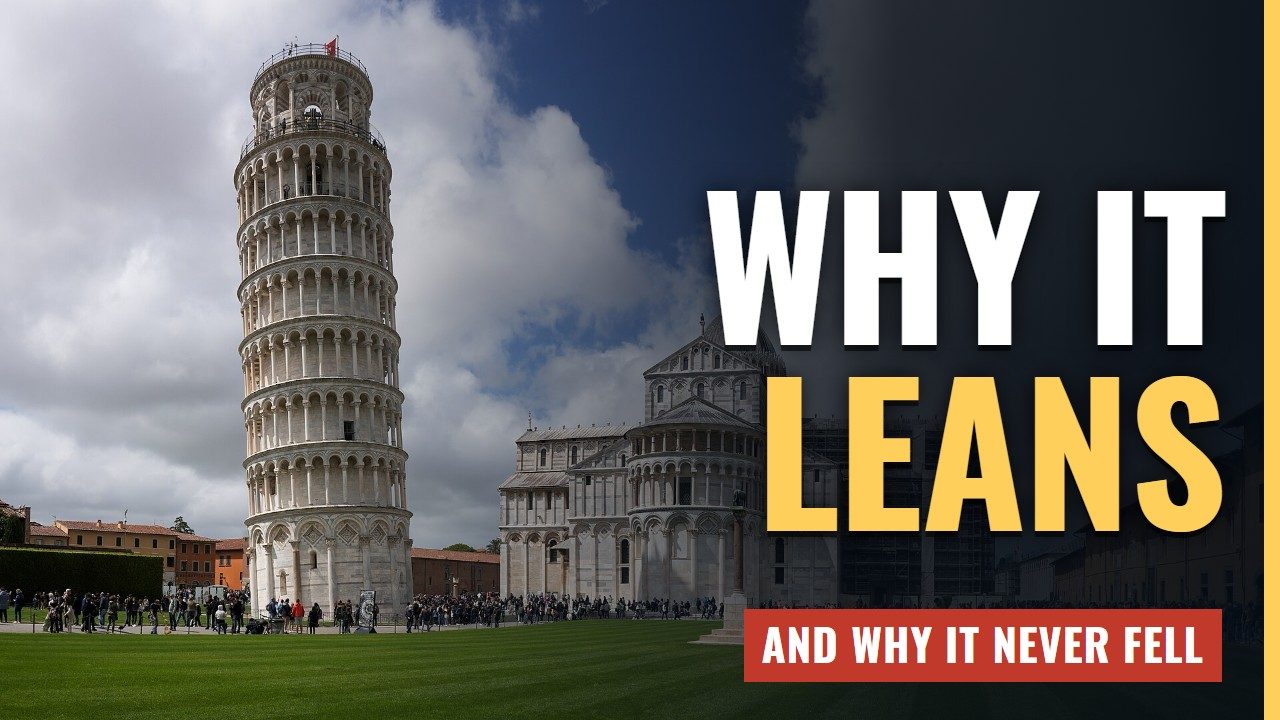
In 1990 the Leaning Tower of Pisa was closed, because it was still moving. Today it is safer than it has been for centuries.
This video explains why the tower leans, why it stood for 800 years anyway, and how engineers saved it: not by pushing it, but by taking 38 cubic metres of soil out from under its high side.
The full story
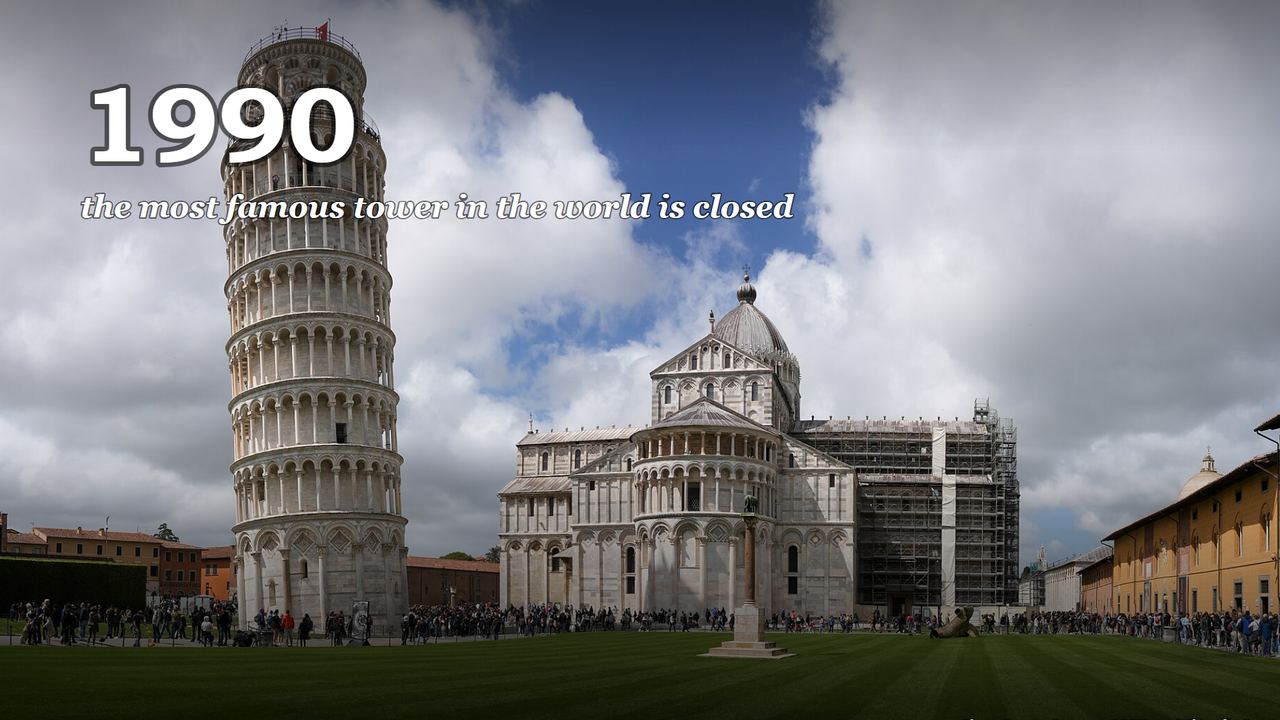
In 1990, the most famous tower in the world was closed to the public. Engineers had been measuring its lean for decades, and the numbers were clear. The Leaning Tower of Pisa was still moving. A little more, and 14,500 tonnes of marble would come down.
It did not fall. Today it is safer than it has been for centuries. This is the story of why it leans, why it stood for eight hundred years anyway, and how engineers saved it by taking away a little soil.
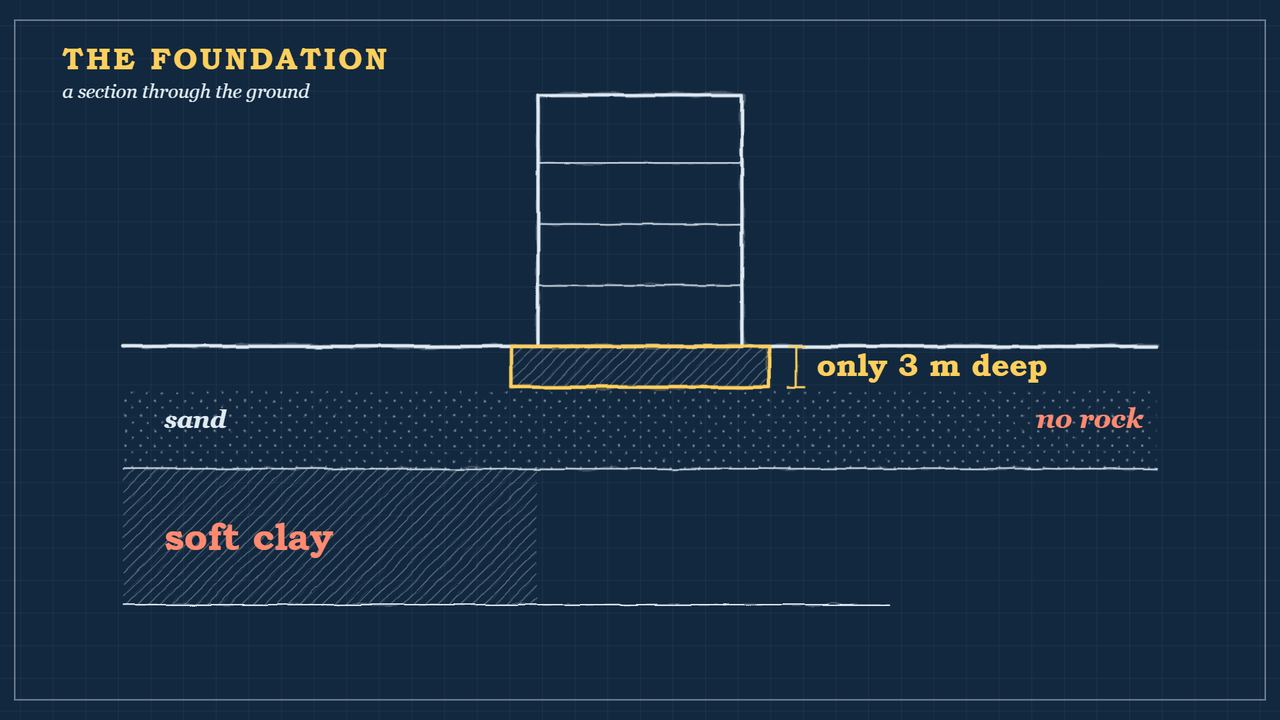
Building began in 1173. The plan was a bell tower, 56 metres tall, for the cathedral of Pisa. Its foundation was only about three metres deep. And under it there was no rock. There was soft clay and sand, left behind by an old river.
Five years later, when the work reached the second floor, the ground on the south side began to give way. The tower started to lean.
Then came the luckiest thing that ever happened to it. Pisa went to war, and the work stopped for almost a hundred years. During that time, the weight of the unfinished tower slowly squeezed the water out of the clay below. The clay became denser, and stronger. If the builders had carried on at once, the tower would almost certainly have fallen.
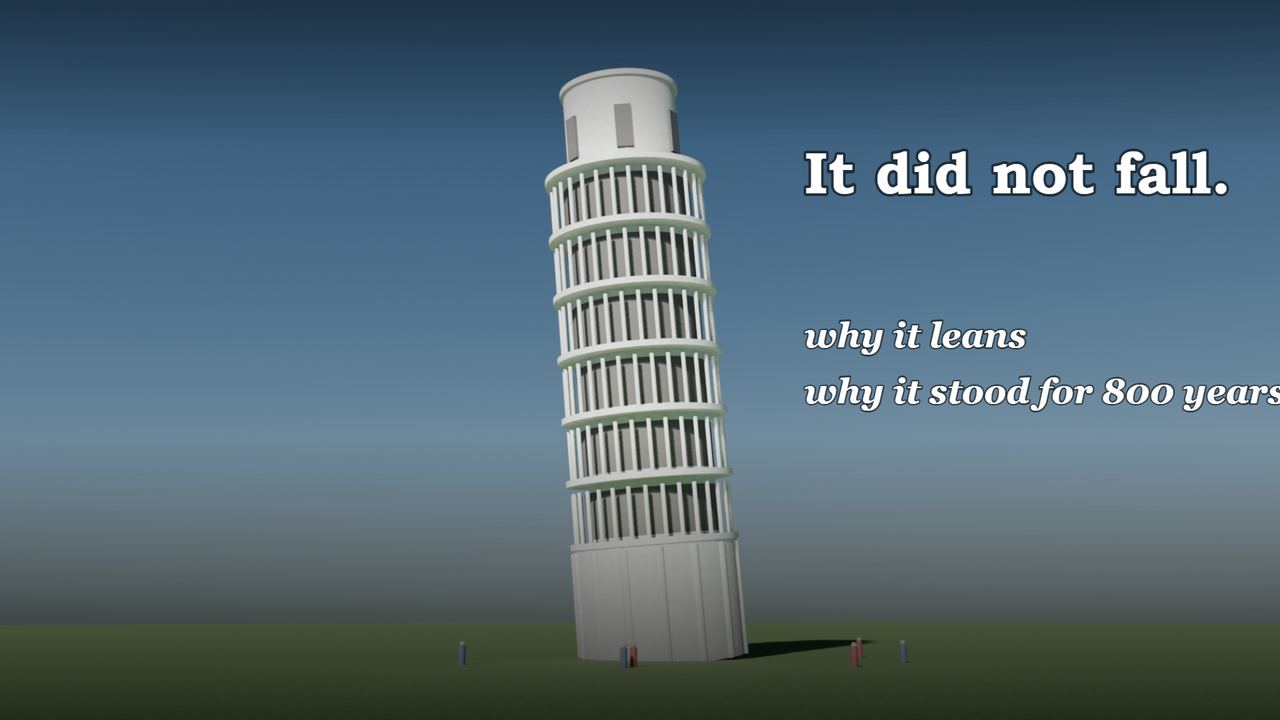
When the work began again, the builders tried to correct the lean. They made each new floor a little taller on the low side. So the tower is not straight. It is curved, like a banana. It was finished in 1372, almost two hundred years after it was begun.
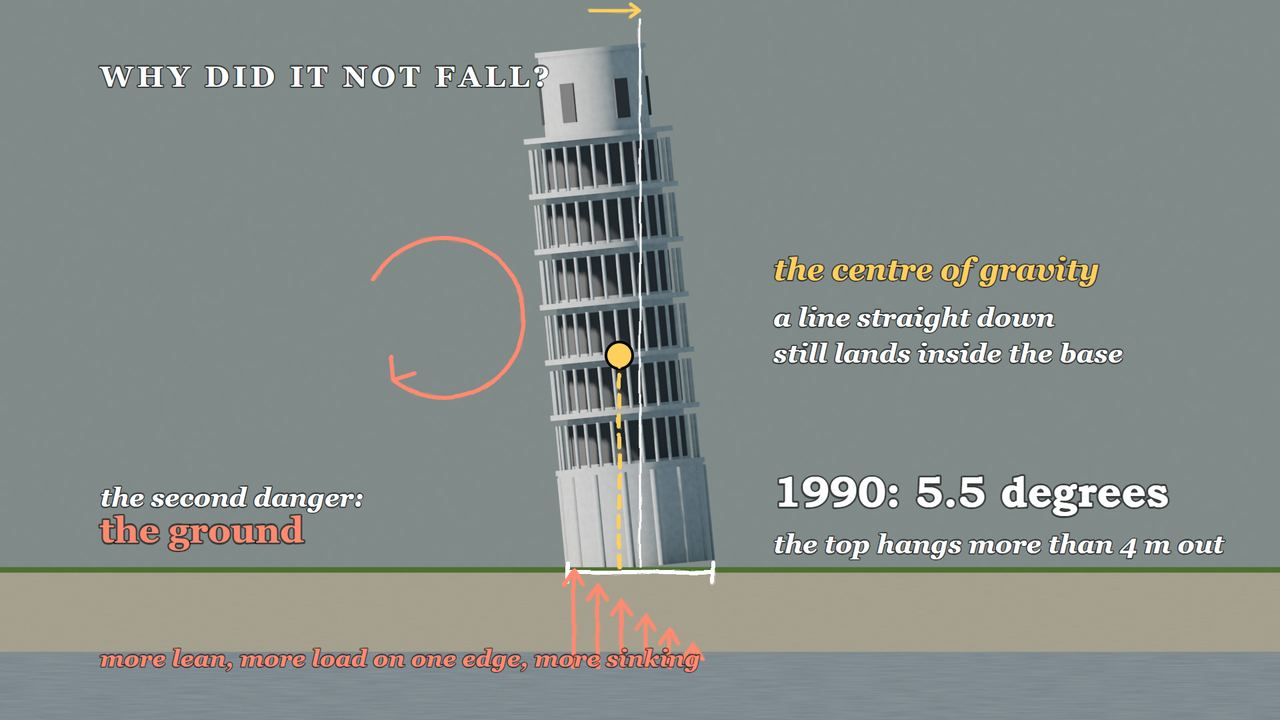
So why did it not fall? Think of the tower as one point: its centre of gravity. As long as a line straight down from that point lands inside the base, the tower stands. But there is a second danger, and it is in the ground. The more the tower leans, the more weight goes onto one edge of the foundation. That edge sinks, the tower leans more, and the circle goes on. By 1990, the lean was five and a half degrees, and the top was hanging more than four metres out.
In 1989, another medieval tower in Italy, in the city of Pavia, collapsed without warning. A few months later, Pisa was closed, and a group of engineers was given the job of saving it. There was one condition. The tower had to stay leaning. Nobody wanted a straight tower of Pisa.
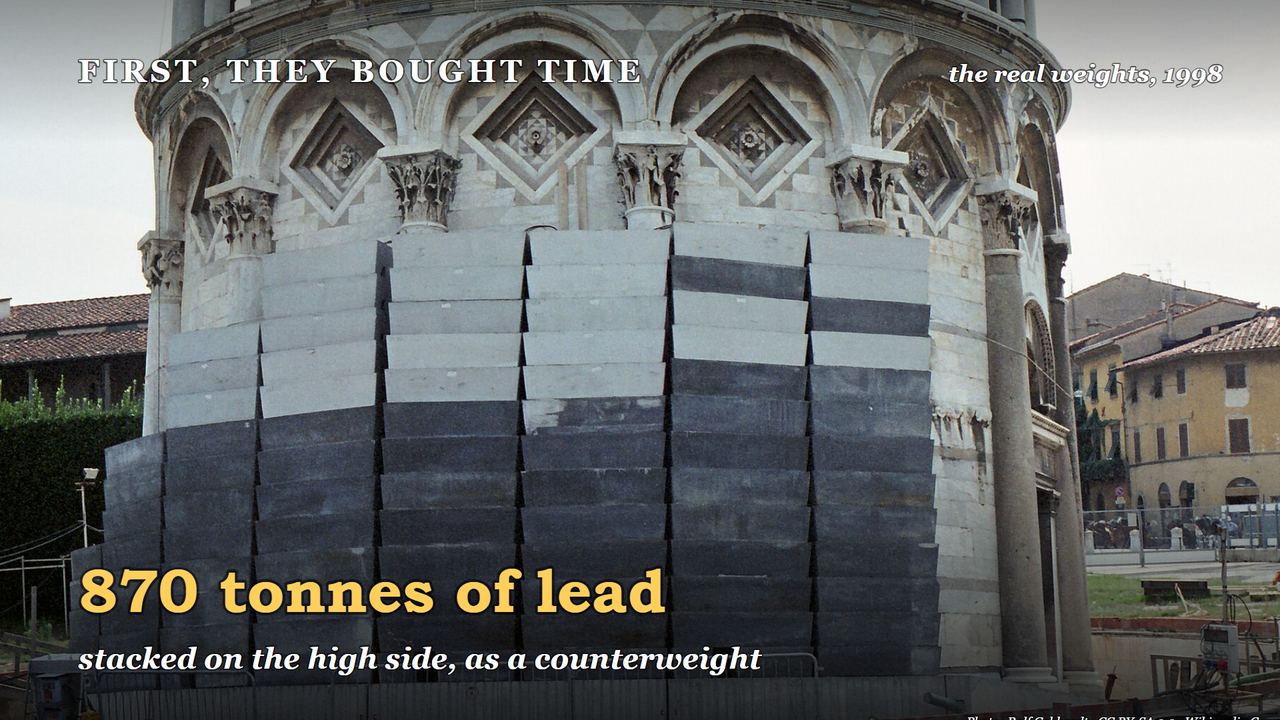
First, they bought time. They tied steel cables around the tower. And they stacked 870 tonnes of lead on the high side of its base, as a counterweight.
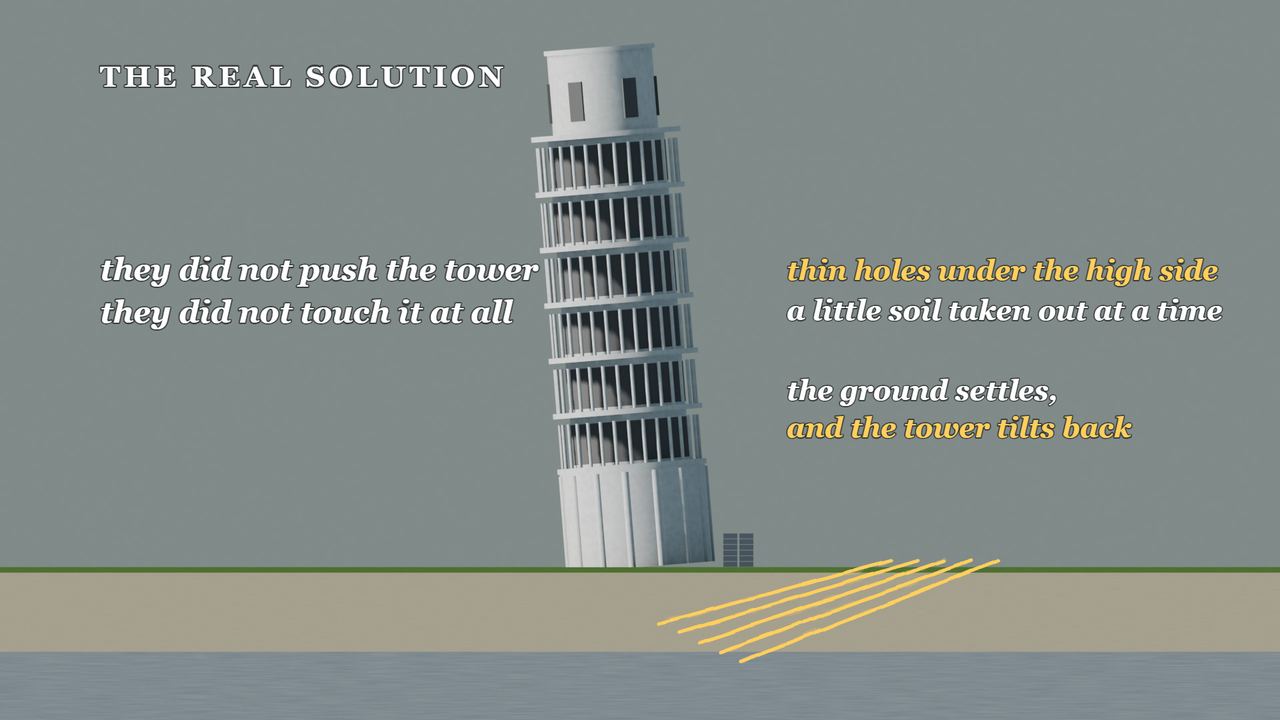
Then came the real solution, and it was beautifully simple. They did not push the tower. They did not touch it at all. They drilled thin holes into the ground under the high side, and took out a little soil at a time. The ground settled by a few millimetres, and the tower tilted back. In all, they removed only 38 cubic metres of soil: about the size of a small room.
By 2001, the top had moved back by 45 centimetres. The lean was under four degrees, where it had been in 1838. The lead was taken away, and the tower was opened again. In 2008, the measurements showed something new. For the first time in its history, the tower had stopped moving.
There is one more surprise. The same soft ground that almost destroyed the tower also protects it. The region has had at least four strong earthquakes since the tower was built, and it survived them all. The tower is stiff, the ground is soft, and the two do not shake in step with each other.
The Tower of Pisa is not a story about a bad building. It is a story about the ground. Every structure is only as good as the soil beneath it. And sometimes, the best repair is the smallest one.
This is The Bending Moment. Thank you for watching.
The Guide
How to Read Structural Drawings
One beam, B2, followed from the plan to the section, the schedule and the general notes, then decoded in the six rebar notations you will meet on real sets.
#5H1616ØT16Ø16N1661 pages · 12 exercises with answers · about 100 abbreviations · PDF
Sources
- the Wikipedia article "Leaning Tower of Pisa" and the works it cites on the stabilisation of 1990 to 2001.
Photo credits
- Tower and cathedral: PaestumPaestum, CC BY 4.0
- Piazza dei Miracoli from the air: Guglielmo Giambartolomei, CC BY-SA 4.0
- Remains of the Civic Tower of Pavia: Quaro75, CC BY-SA 3.0
- Bell chamber: FaceMePLS, CC BY 2.0
- Lead counterweights, 1998: Rolf Gebhardt, CC BY-SA 3.0
- Cathedral and tower at sunrise: MHoser, CC BY-SA 4.0
Photos from Wikimedia Commons under the licences listed. All drawings are original.
The narration uses an AI clone of the author's own voice. All drawings are original.